
If you have been researching the Tepezza lawsuit payout, you are probably wondering one thing: How much compensation can someone actually receive? Over the past few years, this medication has shifted from being viewed as a breakthrough treatment to becoming the center of significant litigation. Patients across the country have alleged that they suffered serious hearing damage after treatment, and many are now pursuing legal action.
In this article, I will walk you through everything you need to know about potential settlement amounts, what factors influence payouts, and what the legal process looks like. I will keep it straightforward and conversational, but grounded in legal and medical realities so you get a clear, expert-level understanding.
Understanding Tepezza Lawsuit Payout and Why Lawsuits Were Filed
Tepezza Lawsuit Payout was approved as a treatment for thyroid eye disease (TED), a serious autoimmune condition that can cause eye bulging, vision problems, and pain. For many patients, it offered relief where other treatments had failed. It was marketed as a targeted therapy that addressed the underlying cause of TED rather than just the symptoms.
However, after wider use in the general population, reports began surfacing about unexpected side effects — most notably hearing-related injuries. Patients described symptoms such as tinnitus (ringing in the ears), muffled hearing, and in some cases, permanent hearing loss. While some level of hearing issues had been observed during clinical trials, many plaintiffs claim the risks were understated or not clearly communicated.
The lawsuits primarily allege failure to warn. The manufacturer, Horizon Therapeutics, which was later acquired by Amgen, is accused of not adequately informing doctors and patients about the potential severity and permanence of hearing damage. From a legal standpoint, this centers on product liability and whether the warning label sufficiently disclosed known risks.
What a Tepezza Lawsuit Payout Actually Covers
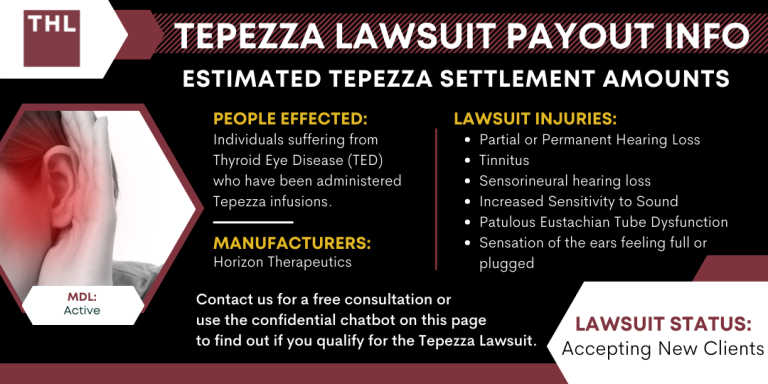
When people hear the phrase “Tepezza Lawsuit Payout,” they often imagine a single lump sum. In reality, compensation is carefully calculated based on multiple categories of damages. Courts and settlement negotiations look at both measurable financial losses and the broader human impact of the injury.
First, there are economic damages. Tepezza Lawsuit Payout are the tangible financial costs linked directly to the injury. Medical bills are at the top of the list. Hearing tests, audiology consultations, hearing aids, cochlear implants, and long-term monitoring can become expensive very quickly. If someone requires lifelong auditory support, those projected future costs are also included in the claim.
Second, lost income is a major component. Hearing loss can interfere with certain professions, especially those requiring constant communication or auditory precision. If someone had to reduce their work hours, change careers, or stop working altogether, those lost wages and diminished earning capacity are factored into the payout calculation.
Finally, there are non-economic damages. These are harder to quantify but often represent the most meaningful part of a settlement. Chronic tinnitus, social isolation due to hearing difficulty, emotional distress, and reduced quality of life all fall under this category. Courts recognize that hearing loss is not just a medical condition; it affects relationships, confidence, and daily experiences.
Estimated Tepezza Lawsuit Payout Payout Ranges
Now Tepezza Lawsuit Payout address the question most people are asking: what are the potential payout amounts?
While no official global settlement has been finalized as of now, legal analysts and attorneys handling these cases have provided projected ranges based on comparable pharmaceutical litigation. Early estimates suggest that lower-tier cases may settle in the range of $75,000 to $100,000, particularly where hearing damage is mild or partially reversible.
For moderate cases involving documented, ongoing hearing issues supported by audiology testing, projected settlements often fall between $125,000 and $250,000. These cases usually involve measurable hearing loss that impacts daily functioning but does not amount to total deafness.
In severe cases involving permanent and substantial hearing impairment — especially in individuals with no prior auditory issues — payouts could exceed $250,000, and in certain scenarios potentially climb higher depending on individual circumstances. However, it is critical to understand that these numbers are estimates, not guarantees. Every case stands on its own evidence.
Factors That Influence the Final Settlement Amount
Settlement amounts are not random. They are influenced by several key factors that can either strengthen or weaken a claim.
One of the most important factors is severity and permanence. Temporary symptoms that resolve after treatment typically result in lower compensation. Permanent hearing damage supported by medical documentation significantly increases case value. Objective audiology tests play a major role in proving injury.
Another factor is medical history. Plaintiffs with no prior hearing problems generally have stronger causation arguments. If someone already had documented hearing loss before taking the medication, the defense may argue that the drug did not cause the condition, or only worsened it slightly.
The overall impact on lifestyle also matters. If hearing loss interferes with work performance, parenting responsibilities, or social interaction, attorneys can argue for higher non-economic damages. Courts and juries often respond strongly to evidence showing how a person’s daily life has changed because of the injury.
The Role of Multidistrict Litigation (MDL)
Many Tepezza Lawsuit Payout cases have been consolidated into multidistrict litigation, commonly referred to as an MDL. This process groups similar federal lawsuits together before one judge for pretrial proceedings. It streamlines discovery, expert testimony, and procedural matters while keeping each individual case separate for settlement or trial.
The advantage of MDL is efficiency. Instead of hundreds of identical discovery battles across the country, the process centralizes key legal arguments. This can accelerate negotiations and provide clearer insight into how juries may respond.
Bellwether trials are often scheduled within MDLs. These are test trials designed to gauge jury reactions and establish a rough valuation framework. If juries return high verdicts in early cases, it can pressure the defendant to pursue a broader settlement strategy.
Will There Be a Global Settlement?
In large pharmaceutical cases, companies often choose to negotiate a global settlement once they can estimate potential exposure. A global settlement typically establishes a compensation matrix. Plaintiffs are then categorized based on injury severity, age, medical documentation, and other factors.
If this happens in the Tepezza Lawsuit Payout litigation, payouts would likely follow a tiered structure. Mild cases would receive lower fixed amounts, moderate cases a mid-range award, and severe or permanent cases the highest tier compensation.
However, negotiations depend heavily on early trial outcomes. If early verdicts favor the defense, settlement values may decrease. If plaintiffs secure substantial jury awards, that often accelerates meaningful settlement discussions.
Should You File a Tepezza Lawsuit Payout
If you experienced hearing problems after receiving Tepezza treatment, consulting a qualified product liability attorney is a logical next step. An attorney will review your infusion dates, medical records, audiology reports, and prior health history to evaluate whether you have a viable claim.
Timing also matters. Every state has a statute of limitations, meaning there is a deadline to file a claim. Waiting too long could permanently bar recovery, even if the injury is legitimate.
Most pharmaceutical injury attorneys work on a contingency fee basis. That means you typically pay nothing upfront, and legal fees are deducted only if compensation is recovered. This structure allows injured individuals to pursue justice without financial risk at the start.
Final Thoughts on Tepezza Lawsuit Payouts
The potential Tepezza lawsuit payout depends heavily on individual circumstances, medical documentation, and how the broader litigation unfolds. While projected settlement ranges provide a helpful reference point, they are not promises.
From a legal perspective, the strongest cases involve clear medical evidence of permanent hearing loss, no prior auditory issues, and documented lifestyle or professional impact. As more cases move through the court Tepezza Lawsuit Payout , clearer valuation patterns will likely emerge.